Wednesday, January 9, 2019

Second Semester Week 1

Welcome back!  Lots of fun in class today....

DEVOTIONS
Our new devotion will be based on the book Do Hard Things.  Plan to read one chapter each week (chapter 1 this week!) and we'll discuss it in class.  It's a pretty easy read and I think you're going to love it!

This semester I'm also introducing an accountability sheet for each student to mark at the beginning of class how much they completed for each strand.  Feel free to take a look anytime!

LATIN
We've finished our review of last year's material and now we're moving on to new stuff!  The pace will now start to slow down.  :)  

We reviewed adjectives and the special declensions of rules 41-43 and 74-76.  This week, you're finishing up Lesson 16 and moving into the beginning of 17 (active & passive voice).  Make sure you are staying on top of new vocabulary!

NATIONAL LATIN EXAM
Those who signed up will take the NLE Introduction-level exam on Monday, March 11, in class.  The best way to begin preparing for the exam is to practice the vocabulary I set up on Quizlet (I'll email you the link to request to join the class) and get familiar with Roman mythology (I also made Quizlets for this).  Mr. Seitz will review some with the kids during study hall, and I am working on a summary resource to send around.

LOGIC
We had 6 students successfully complete the 25 chart/13 day challenge, and another 2 write out all 3 charts from memory in class.  Good job!  Appendix A will be the most important one for now, so if you weren't able to finish this over break, focus on getting Appendix A down old as soon as possible!  (Appendix B will be used in Unit 2, and C in Unit 3.)

We discussed some of the many areas in the Bible that address logic, including:

2 Corinthians 10:5:  “We demolish arguments and every pretension that sets 
itself up against the knowledge of God, and we take captive every thought to 
make it obedient to Christ.” 

1 Timothy 6:20-21:  “Timothy, guard what has been entrusted to your care.  Turn 
away from godless chatter and the opposing ideas of what is falsely called 
knowledge, which some have professed and in so doing have departed from the 
faith.”

Logic and reasoning even appear when the Pharisees try to challenge Jesus’ 
authority in Mark 11:27-33!

We are now entering Intermediate Logic and the study of propositional logic:  evaluating the truth value of a proposition (i.e., a statement) by evaluating its component parts.  Note:  In second semester, we only cover Units 1-3.  Unit 4 is optional; and Unit 5 is not assigned.

This week, complete all reading and exercises for Lessons 1-5, and practice the vocabulary. 

SCIENCE
Welcome to Defeating Darwinism!  We'll spend 10 weeks reading, summarizing, and discussing how to think logically about the theory of evolution.  Written by a reformed atheist, the book is aimed at upper-level high school students and college students - the reading can be difficult, but remember:  Hard is not bad!  Get used to hearing me say that. ;) 

You will read (several times) one chapter each week, in addition to summarizing and outlining it.  It is important that you stay on top of your summaries and keep track of them!  I'm emailing you the outlines we discussed in class that will help you learn what and how to summarize - these shells provide a lot of guidance initially and then gradually wean you so that you are writing your own summary unassisted by week 8.  You can either print the shells and handwrite your summary, or type it on the computer - but make sure you print a copy to bring to class each week if you choose the latter!  And come prepared to discuss - this book is a lot of fun and very enlightening if you stick with it!

In class, I asked students to draw a picture of an alien.  Not surprisingly, every student drew something imagined from another planet in outer space.  We discussed where they got their ideas from - movies, books, cartoons - basically culture and the media.  Then I pointed out that the Bible talks about aliens and related words over 70 times!  We considered what it means to have a biblical worldview, and why no one's initial reaction was to draw that kind of alien first.

I asked which students think comes first:  Does science inform your worldview, or does your worldview inform science?

How to Read:
We reviewed the Highlighting Method used in Challenge A (It Couldn't Just Happen).  If students successfully tried that method and found one that works well for them, I encouraged them to stick with it.  We also should add these steps to this strand:

1st Read - Count the Cost
Look at the chapters, page numbers, sections, pictures, font sizes.  Ask yourself: What is this going to cost me?  (Luke 14:28 “For which of you, desiring to build a tower, does not first sit down and count the cost, whether he has enough to complete it?”)

2nd Read - Touch / Scan
Read the first and last paragraph of the assigned text.  Then run your finger down the text, touching each line and every word.  DO NOT "read", but rather, allow your brain to scan it.  You might want to start noting/highlighting names, dates, places or "structure" words (like ordinal numbers, lists, etc.), or you can save this for the next read-through.

3rd Read - Actually Read + Highlight 
Now read at a normal pace.  Highlight definitions, main arguments, favorite passages, memorable quotes, etc.  

4th Read - Re-read & Summarize
Read substantively one more time, summarizing and outlining as you go.  Ask yourself: What is the author trying to convey in the chapter?
  • What’s the big picture? 
  • How does the author build the argument in the chapter? 
  • Does he give examples, definitions, tell a story? 
  • Pull out the information that’s important and understand why it’s important.
Don't just copy!  Think it through, decide what needs to be included, and put it in your own words.  This is essential to making the material your own.

Include vocabulary and explanations of concepts.  Place vocabulary words, key concepts, and list of people noted within the chapter at the very beginning of each chapter outline.  It's easier to find and easier to study!

Finally, we read the Introduction together and outlined some of the main ideas:

According to Mr. Johnson, the most important question of our lives is: 
Is there a God who created us and cares about what we do?

Indoctrination of young people in schools in naturalism.
Under 10% of the general population believes in scientific orthodoxy.
Remaining 90% are split between biblical creationists & theistic evolutionists.

People understand the theory of evolution better than scientists do.  Scientists/professors know details but not the basics.  
“Scientific fact” vs. ideology that goes beyond the facts.

Book = education on HOW to think about evolution.
Freeing people to think about evolution critically as they would any other important subject.
Requires precise definitions and good thinking habits [LOGIC!]
Apply skills to evolution, which has been protected far too long from critical thinking by law and academic custom.

Mr. Johnson data is old (1997) and we wondered if there was anything more recent.  I found something from 2007 if you want to check it out:  https://news.gallup.com/poll/21814/Evolution-Creationism-Intelligent-Design.aspx?fbclid=IwAR3a4A4je6Bx-FjrcEKOL-exyvWJLQ89WhKsWcsAThZInm4XXicgenA2aB8

This week, touch/scan/read chapter 1 and outline all major points.  You might find this link helpful (it's the NABT position statement on teaching evolution):  https://nabt.org/Position-Statements-NABT-Position-Statement-on-Teaching-Evolution?fbclid=IwAR3LvWcbKkMjJ1PCcyfbSKg_gIVaGarKK3h9eQb4zAlRKxm3okuJ7ZO780w

MATH
We tried something new:  I introduced four lessons from Saxon, then students paired up to present their own math problems to each other.  We'll do this again next week, in addition to drawing one student's name to present to the entire class.  This way, everyone is sharing a problem each week, so come prepared!

SHORT STORIES
We previewed some great general questions to consider for every story (p. 14-15), and worked through Freytag’s Pyramid (a story diagram).  I'll circulate an example we can use in discussing the short stories we read.

We read aloud The Lion & the Mouse and answered the review and thought questions that followed it.  We also introduced ideas about THEME (p. 21).

This week, reread p. 21 about Theme and keep it in mind as you read the three assigned stories (p. 23-37).  Consider the review and thought questions and be prepared to discuss them in class.  Also bring a Bible verse that relates to what you read and 5 story ideas (written down!) to discuss in community.  

MOCK TRIAL
We'll have a MT notebook "scavenger hunt" in class next week, so continue to read through the case materials and get familiar with everything.

I explained the critical importance of everyone pulling their own weight in Mock Trial.  There will be no riding coattails!  Each week, students will submit their work to me and it will be shared with classmates, so be prepared!

There can be anxiety surrounding Mock Trial, but I promised you this is going to be fun despite any fears!  This week, read through the case again, organize and tab your case materials, and complete these additional tasks:

1.  Analyze the statements/reports of Chaney & May (think about what you learned for Defeating Darwinism - highlighting/summarizing; asking what’s important? Consider creating an ANI chart where one column lists points favorable to the prosecution, one the defense, and one "interesting".

2.  Rewrite statements for Chaney & May in your own words.  If a person doesn't have a witness statement, create one using the materials you do have for that person.  This develops familiarity & understanding.

3.  Prepare a timeline that includes all the information you learn from Chaney & May.  It works well to keep a running document on your computer.  Don't exclude any information you think is irrelevant now - it could prove to be important later as you learn more about the case.

POSTREMO
* Don't forget our Challenge Social at Dart Warz this Saturday - it looks like the times now are 5:30-8:00 p.m.  And our Parent Meeting will be from 5:45-7:45 pm right nearby at Starbucks.  

* We'll watch The Hiding Place at Faith's house on Saturday, Jan. 19, at 7 p.m.

* We'd love to have you join us at Latin Study Hall on our new day and time: Tuesdays from 10:15-11:45 a.m.!

Blessings on your week!  ~ Mrs. D


Sunday, January 6, 2019

Week 15

Excellent job during blue book exams!  People were focused and working hard - you deserve a wonderful break! 

As you know, there are a few things to work on to be fully prepared for second semester - use the checklist I gave you in class.  I also emailed several resources to you, including Latin Verb Chart #2 and aids for Logic appendices.

You should have 25 handwritten and dated copies of each appendix (A, B, and C) by January 7, and you may not count more than 2 per day (of each appendix) - so it will take you a minimum of 13 days to finish this task!  There will be a special reward for all students who bring their copies to class on Monday, January 7!

Don’t Forget:

* Jot down any ideas that come to mind about short stories in the spiral notebook I gave you (or some other set place).

* Prepare a math problem for class on January 7th!

* Finish writing your Tanglewood Tales essay.

* Read through your Mock Trial notebooks - multiple times!

* Check out the NLE quizzes in our Quizlet class and start practicing.

* Work on your logic charts - and bring them to class on Monday!

* Make sure you know Latin Verb Charts 1 & 2 fully!

I’m praying for a productive finish to your year and beginning to second semester, as well as rest and fun times over break!  Hugs ~ Mrs. D

Wednesday, December 5, 2018

Week 14

DEVOTION
For our devotion today, we discussed Isaiah 53:

1 Who has believed our message and to whom has the arm of the Lord been revealed?

2 He grew up before him like a tender shoot, and like a root out of dry ground.
He had no beauty or majesty to attract us to him, nothing in his appearance that we should desire him.

3 He was despised and rejected by mankind, a man of suffering, and familiar with pain.  Like one from whom people hide their faces he was despised, and we held him in low esteem.

4 Surely he took up our pain and bore our suffering, yet we considered him punished by God, stricken by him, and afflicted.

5 But he was pierced for our transgressions, he was crushed for our iniquities; the punishment that brought us peace was on him, and by his wounds we are healed.

6 We all, like sheep, have gone astray, each of us has turned to our own way; and the Lord has laid on him the iniquity of us all.

7 He was oppressed and afflicted, yet he did not open his mouth; he was led like a lamb to the slaughter, and as a sheep before its shearers is silent, so he did not open his mouth.

8 By oppression and judgment he was taken away. Yet who of his generation protested?
For he was cut off from the land of the living; for the transgression of my people he was punished.

9 He was assigned a grave with the wicked, and with the rich in his death,
though he had done no violence, nor was any deceit in his mouth.

10 Yet it was the Lord’s will to crush him and cause him to suffer, and though the Lord makes his life an offering for sin,
he will see his offspring and prolong his days, and the will of the Lord will prosper in his hand.

11 After he has suffered, he will see the light of life and be satisfied; by his knowledge my righteous servant will justify many, and he will bear their iniquities.

12 Therefore I will give him a portion among the great, and he will divide the spoils with the strong, because he poured out his life unto death, and was numbered with the transgressors. For he bore the sin of many, and made intercession for the transgressors.

We had a wonderful discussion about the prophecies in this passage that were fulfilled 450 years later!  

BLUE BOOK EXAM
We reviewed material and discussed extensively what would likely be on the exam.  Students should have been taking notes in their note-taking journals.  I also detailed much of this in last week's blog post, so I won't repeat it here.

LATIN
Students now know everything they need to completely fill out Verb Chart 1.  And after the upcoming week's material, you can completely fill out Verb Chart 2, as well!

Lesson 15 introduces the Perfect System (indicative active), which includes the perfect, pluperfect, and future perfect tenses.  This is the last bit of material that was covered in Challenge A.  The pace should slow down a bit when we reconvene in January!

To find the perfect active stem, you drop the ending -ī of the 3rd principal part (see p. 155).  We went over Chart 2 in detail, and everyone realized how easy this chart is since nearly everything is identical across the conjugations!  See rules 174, 177-179, 349 (PERFECT tense), as well as 175-176, 180-185, 350-351 (PLUPERFECT & FUTURE PERFECT tenses).

Verb Chart 2 will not be on the blue book, but you should know it cold by week 1 of second semester!

The class then worked through reading and translating exercise 159 together, and we were all pleasantly surprised how well everyone did and how natural it was to translate the Latin sentences into English!

ASTRONOMY
Students presented their papers on Stephen Hawking, and we had time to discuss his wife, faith, and work afterwards.

We compared and discussed these two quotes:

“Every song has a composer, every book has an author, every car has a maker, every painting has a painter, and every building has a builder. So it isn't irrational to take this simple logic a little further and say that nature must have had a Maker. It would be irrational to believe that it made itself.”     
(Ray Comfort)


vs.

Hawking‘s answer to the question “Is there a God?” He said, “No, I think the universe was spontaneously created out of nothing, according to the laws of science.” After all, he argues, “If you accept, as I do, that the laws of nature are fixed, then it doesn't take long to ask: What role is there for God?”

We also learned that scientists recently discovered that it seems like a meteor came near the Earth in the Dead Sea area, wiping out a good-sized civilization and landscape about 3700 years ago.  That is almost exactly when biblical scholars believe Sodom and Gomorrah was destroyed by God. 

Hawking was diagnosed with ALS at 21 years old and only given 2 years to live.  But he lived 55 years longer!  Students talked about how sad it was that God gave him all that extra time to repent and he never did; how gracious God was to give him those years and the brilliant mind he did, but Hawking used it to reject God.

We then considered the question:  If you only had 2-3 minutes in an elevator with Hawking, how would you convince such an intelligent man that there is a God?

It was interesting to note that Billy Graham died just a few weeks before Hawking.

Don't forget:  completed shoe boxes are due next Monday!

LOGIC
We discussed a few more "problem exercises" in lessons 30-32, and then I introduced lessons 33-36.  These lessons involve informal fallacies, and much of it was familiar to students, thanks to The Fallacy Detective in Challenge A.

These lessons divide informal fallacies into 3 types:  fallacies of distraction, ambiguity, and form.  Lesson 36 then teaches how to detect these fallacies by asking 2 questions.

Finally, we began learning a good (simpler) method for memorizing Appendices A & C for intermediate logic second semester.  We'll finish this up next week.

MATH
Thank you, Andrew W. and Addie, for being prepared and sharing a math problem.  

Students do not need to bring a problem to discuss next week, but everyone should be prepared with their math assignment to present on January 7!

CURRENT EVENTS
We changed things up this week: rather than split the class in half and spend time organizing and writing arguments, students paired up and presented their side of the issue solo: Should the federal government increase the federal minimum wage.  Great job!  It was a lot of fun to hear everyone's speeches.

Your assignment this week is to prepare your elevator speech, which will be given after lunch next Monday.  A few reminders:

- our issue is:  Should religious holiday displays be allowed on government property?

- the speech must be 1-2 minutes long (do not go over 2 minutes!)

- the speech must be completely memorized

- in other words, you may not carry anything up to the stage when you present

- that being the case, when you practice your speech this week, also practice what you are going to do with your hands!  (Hint: incorporate some hand gestures!)

- the Guide (p. 91) explains the elevator speech further

- in general, you should include the elements of Essay #6 or 7 from LTW; but you may have to condense or cut some parts due to the time constraint

- you may choose either side of our issue to talk about

- don't omit an exordium and refutation, however!

LTW
Students shared their issue and 3 favorite proofs.  We then discussed what narratio is, why we need it, and how to write it.  This week, students will sort their ANI chart and write an outline of their essay.  Now they are to write their paper using the LTW #7 essay form, as well as complete worksheets on exordium, amplification, division, refutation & narratio.

At our blue book exam on Monday, students should bring their completed outline.  We will review these Monday afternoon, and if students find they have extra time during the morning exams, they may work on drafting their essay from the outline.  The essay will not be part of the assigned exam, however.  The essay must be completed by January 7.  Bring your essay that day because we will share in class.

We wrapped up our day with a continued discussion on whether Hawthorne presents true heroes through the characters of Tanglewood Tales.

POSTREMO
- Refer to your notes, my emails, and last week's blog post for guidance on the blue book exams.  We will begin right at 8:30 a.m. next Monday.  The exam will last at least the morning (8:30-12:00/12:30).  In the afternoon, we will do our Shoe Box Activity, review week 15 assignments for over Christmas break, and have some fun!

- Don't forget to bring a healthy snack and a sweet treat next Monday!  And a pen, pencil, and something quiet to do if you finish a section early (e.g., a book or your LTW outline).

- Our All-Challenge Christmas Potluck is Friday, Dec. 14!

- MOCK TRIAL DATES are April 24 (9:00-1:00) and May 1 (8:30-12:00).

~ Love, Mrs. D.

Thursday, November 29, 2018

Week 13

DEVOTION

For our devotion today, we looked at Hebrews 11:

"Faith is being confident of what you hope for and sure of what you do not see…." Hebrews 11:1

“All these people were still living by faith when they died. They did not receive the things promised; they only saw them and welcomed them from a distance, admitting that they were foreigners and strangers on earth.“  Hebrews 11:13

“These were all commended for their faith, yet none of them received what had been promised….”  Hebrews 11:39

We discussed waiting, and its relationship with faith (they go hand in hand - waiting is the embodiment of faith!).  Several students shared something they have waited a long time for, and we talked about how difficult that can be, especially in our culture of instant gratification.  Advent is about faith and waiting!  I challenged students to think about something they were/are waiting on God for this year.

At the close of the Old Testament, God's people waited for the Messiah for 400 years!  God's timing can be very different from ours, but the story of Jesus' birth gives us assurance and joy: even though the waiting lingered for centuries, God broke through at just the right time!

Are we willing to be faithful and wait upon God?  When nothing seems to be appearing on the horizon, can you be still and trust?  God *always* keeps His promises!

LATIN
Students quizzed themselves on Verb Chart 1 and the Pronoun Chart.  Now you know where your weaknesses remain - let's get those charts memorized!  After this coming week, you should be able to fill in EVERYTHING on these two charts!

This week you are completing Lessons 13 and 14.  Lesson 13 is the 4th Conjugation, with the model verb audiō, audīre, audīvī, audītus (to hear - rule p. 43).  Everything you need for the 4th conjugation on Chart 1 can be found in rules 167, 170, and 173.

We also discussed intransitive verbs like veniō that cannot take a direct object.  The 4th principal part of these intransitive verbs ends in -um, not -us  (e.g., ventum).

Lesson 14 covers the imperfect and future indicative tenses of SUM (to be).  This is found in rules 347 and 348, and with it you will be able to fill in the rest of Chart 1.

I gave students a summary of verbs and we went through it together, including how to build verbs:

1. Find the stem
2. Add the indicator vowel 
3. Add the tense indicator
4. Add the personal ending

For example:  We do seize the gate.

seize:   occupō, occupāre, occupāvī, occupātus
2nd principal part = occupāre; -āre verbs are 1st conjugation
1. Stem = occup-
2. Add indicator vowel : ā = occupā    
3. (No tense indicator needed for present tense)
4. Add personal ending (1st plural; we): -mus  =  occupāmus

Then gates = porta, portae 
Singular direct object = accusative singular ending (portam)

Portam occupāmus.

BLUEBOOK TIPS:
- Study vocabulary so that you might be able to identify Latin words depicted in a drawing.

- Fill in Verb Chart 1, the pronouns chart, and the noun declensions chart.

- Translate from Latin to English and vice versa.

CURRENT EVENTS
Students did a great job this week of speaking extemporaneously on our topic:  Should curfews be imposed on minors?  I was also impressed with the various Bible verses they brought in.

The topic to research this week is:  Should the federal government raise the federal minimum wage?

We defined terms, including federal and wages.  We discussed comparing the experiences in states that have already increased their minimum wage with states who have not, and what factors might make an increase more or less successful.  Students also brainstormed about the relationship between wages and creating jobs and attracting businesses.

We will handle next week's discussion a little differently.  Students will be paired up to debate both sides.  Everyone will need to be on their "A" game!  You should prepare your proofs and arguments IN ADVANCE.  Really think through each of the required elements so that you are ready to present your arguments on Monday (we will not be spending time preparing outlines in class).  Each person will present their proofs individually, instead of sharing the presentation of one outline.

ASSIGNMENT:
Find one affirmative and one negative article.

Find a Bible verse to support your argument.

PREPARE A NOTECARD FOR EACH ARTICLE:

 - On one side: exordium, 3 proofs/subproofs, amplification

 - On the back side, your refutation, notes on your counter-thesis, two strong counter-proofs, and any sub-proofs needed to adequately explain the counter-proofs, statement about what is wrong with each counter-proof, and a conclusion as to why the counter-thesis is not persuasive.

Do this for each article!

Bring notecards and articles, and be prepared to present!

BLUEBOOK TIPS:
Part of your bluebook exam will be you elevator speech on religious displays during class on Week 15.  This is to be a 1-2 min. MEMORIZED speech using the Essay #6 form from Lost Tools of Writing.

You should also be prepared to write persuasively about your favorite current event.

ASTRONOMY
Students presented their posters and research on the different classes of galaxies and Edwin Hubble.

This week you are researching our final astronomer, the English astrophysicist Stephen Hawking (1942-March 14, 2018).  You will write a five-paragraph essay, including: 
- Introduction
- His background (including his faith - you might be interested to compare quotes by him over time)
- His achievements, including research on black holes
- The influence of his research on us today (e.g., Big Bang Theory of Origins)

Students also have their SHOEBOX ASSIGNMENTS, which they will complete and bring to class on Week 15.

BLUEBOOK TIPS:
Practice building a timeline for astronomy; write about how our astronomers have influenced and affected you.

MATH
Thank you, Emily and Greta, for sharing a math problem.  Everyone please remember that part of your assignment each week is to prepare a math problem using the 5 Common Topics discussion chart and bring it to class.

BLUEBOOK TIPS:
- Multiplication drills 
- Basic Math Facts
- Solving equations from your math curriculum

LOGIC
We discussed "problem exercises" in lessons 30-32.  Students have one more week to finish these lessons and exercises.  We then discussed in a bit more detail enthymemes (lesson 30), hypothetical syllogisms (lesson 31), and establishing conclusions (lesson 32).

LESSON 30 Enthymeme:
- an argument in which a statement is unstated and assumed;
- a syllogism with one assumed statement (could be premise or conclusion).

“You aren’t my friend, because all of my friends own sports cars.”
Conclusion:  No you are my friends.
Premise:  All my friends are owners of sports cars.
What terms must the missing premise contain?   You; owners of sports cars

Missing statement:  You are not owners of sports cars.

LESSON 31: HYPOTHETICAL SYLLOGISMS

Hypothetical: statement affirms an outcome based on a condition; has the form: “If P then Q.”
Translate hypothetical statements as UNIVERSALS (A, E).
Can be examined differently than categorical syllogisms.

Pure Hypothetical Syllogisms: only employs hypotheticals.

If P then Q. P > Q
If Q then R. Q > R
Therefore, if P then R. . : P > R

If I eat my vegetables, then I will grow.
If I grow, then I will be a giant.
Therefore, if I eat my vegetables, then I will be a giant.

If… = antecedent (P) Then… = consequent (Q)

But it can be INVALID:
 If you are human, then you have a nose.
 If you are an elephant, then you have a nose.
 Therefore, if you are human, then you are an elephant.

If P then  Q. P > Q
If R then Q. R > Q
Therefore, if P then R. . : P > R

INVALID ARGUMENT:  AAA-2

2.  Mixed Hypothetical Syllogisms: combo of hypothetical & categorical statements.

If P, then Q.
P.
Therefore, Q.

If I eat that brownie, I will be full.
I eat that brownie.
Therefore, I will be full.

= Modus Ponens P > Q
P
Therefore, Q.

If P, then Q.
Not Q.
Therefore, not P.

If I eat that brownie, I will be full.
I am not full.
Therefore, I did not eat that brownie.

= Modus Tollens P > Q
~ Q
Therefore, ~ P.

3.  Notice the NON-SEQUITUR:

If P, then Q. P > Q
Q. Q
Therefore, P. Therefore, P.

If I eat that brownie, I will be full.
I am full.
Therefore, I ate that brownie.

FALLACY = affirming the consequent
(Could be lots of reasons you are full!)

If P, then Q. P > Q
Not P. ~ P
Therefore, not Q. Therefore, ~ Q.

If I eat that brownie, I will be full.
I did not eat the brownie.
Therefore, I am not full.

FALLACY = denying the antecedent
(Could be full even without eating the brownie!)

LESSON 32:   ESTABLISHING CONCLUSIONS
We’ve been analyzing syllogisms - determining the (in)validity of existing arguments.  But we can build valid arguments, too!

There are 24 valid forms (see p. 237).  
1. Take the statement you want to prove and make it the conclusion.
2. Then find a valid figure/mood and build the premises to prove the conclusion!
3. Place known terms (major & minor from the conclusion) into the syllogism.
4. Find a middle term that makes the conclusion true - affirming the conclusion.

BLUEBOOK TIPS:
- Square of Opposition
- Immediate Inferences
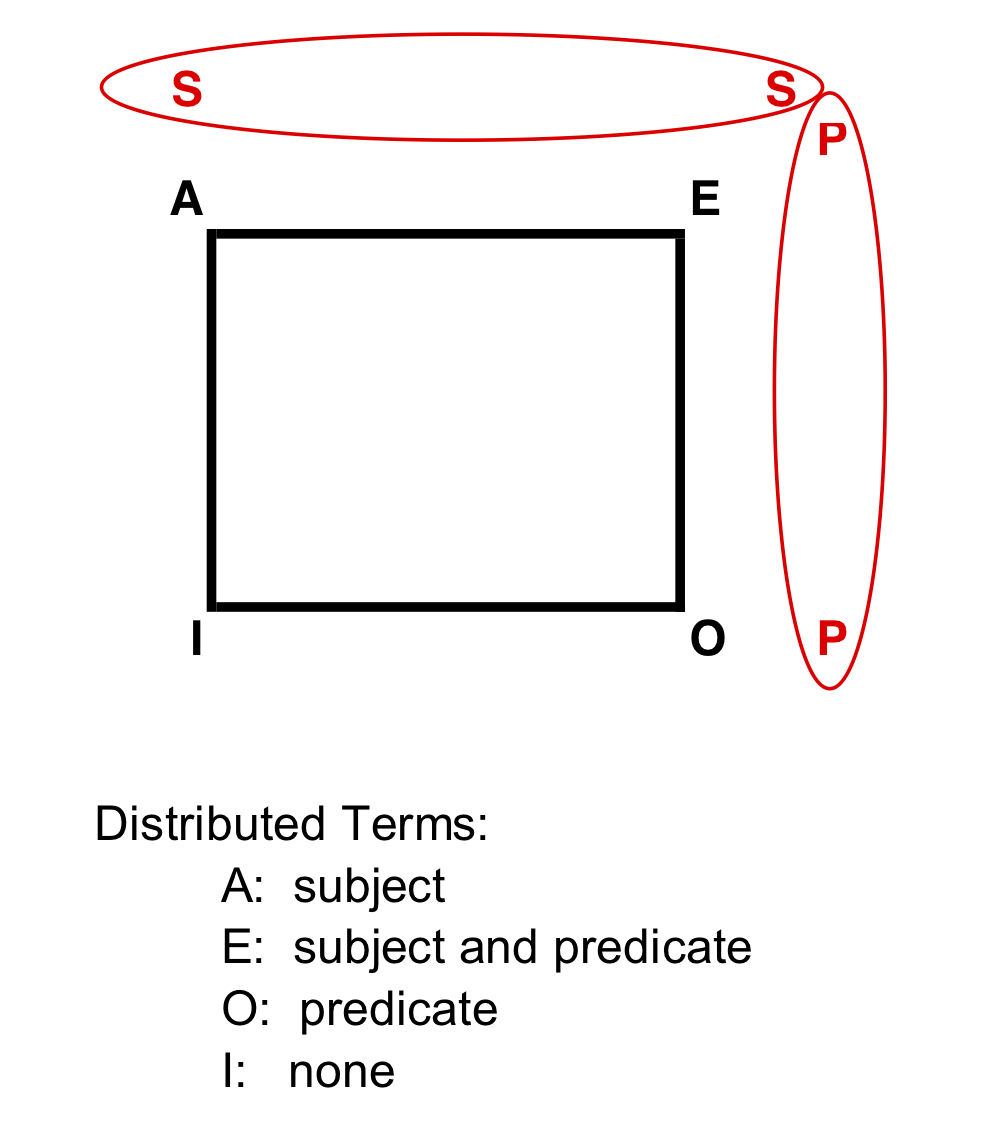
- Distributed Terms
- Syllogisms:  Mood & Figure

The 3 rules for putting statements into Standard Categorical Form:
1. Statement must begin with all, no, or some.
2. Verb must be a state of being verb (is, are, was, were, will be, etc.).
3. Both subject and predicate must be a noun or noun phrase.

Translate an argument into a standard categorical syllogism and label/identify what you know (e.g., major term, minor term, middle term, premises, conclusion, mood, figure, validity, and/or any formal fallacies).

LTW
Students presented their essays on Corrie ten Boom and The Hiding Place.  Very nice job!  We then discussed Tanglewood Tales and why we should study mythology.  We considered what makes a true hero and whether Hawthorne successfully presented a true hero in his book.

We compared the stories of The Minotaur, The Pygmies, Circe's Palace, Dragon's Teeth, The Pomegranate Seeds, and The Golden Fleece.

ASSIGNMENT:
Create your own issue from one or more of the stories
Complete assigned worksheets (on comparison, definition, circumstance, relation, alliteration)
We will use the Essay # 7 format this time: exordium, parallelism, simile, antithesis, refutation, amplification, and NARRATIO.
Next week, bring in your completed ANI chart with 30 items in each column!

BLUEBOOK TIPS:
You will write your Tanglewood Tales essay at home (before or after Week 15).
In class, be prepared to show your skills with LTW by writing in other strands.

POSTREMO

- Our next All Challenge Social is our Christmas Potluck on Friday, Dec. 14!  Details are forthcoming, but mark your calendars - it's going to be A LOT OF FUN!!!

- I reserved a room at the Lone Tree library for next Tuesday, Dec. 4, from 9:00-12:00 if you would like to review together or ask any questions in preparation for the exam.  Please let me know by Sunday if you plan to attend.  No pressure at all!  But if there is not interest, I need to cancel the reservation.

- Don't forget our MOCK TRIAL DATES:  April 24 (9:00-1:00) and May 1 (8:30-12:00).

- Great job on the craft fair!  We have such a talented group - I loved seeing all you did!

- If you haven't checked out TeenPact yet, please do!  February 18-22, 2019, at the Capitol downtown.  https://teenpact.com/states/co/ 

~ Love, Mrs. D.

Tuesday, November 6, 2018

Week 11

DEVOTION

For our devotion today, we considered one of the ten Booms' favorite verses (Psalm 91:1) and several related passages:

PSALM 91:1 (NIV): Whoever dwells in the shelter of the Most High will rest in the shadow of the Almighty.

PSALM 119:114 (ESV): You are my hiding place and my shield; I hope in your word. 

PSALM 32:7 (ESV): You are a hiding place for me; you preserve me from trouble; you surround me with shouts of deliverance.

PSALM 46:2 (NIV): Therefore we will not fear, though the earth give way and the mountains fall into the heart of the sea....

Corrie ten Boom once said:  “If we are hidden with Jesus in God, then peace remains. We are not afraid, even if the earth gives way and the mountains fall into the heart of the sea (Psalm 46:2). Even if it is night, we can experience the promise that ‘He who dwells in the shelter of the Most High will rest in the shadow of the Almighty’ (Psalm 91:1). Hallelujah, what a sure security!”

We discussed the question: Where did Corrie get her courage from?  
Her unique kind of courage did not come from an unusually strong constitution, but from hours spent in her own special “hiding place.” That place, for Corrie, was anywhere in the presence of Christ Jesus…even in a concentration camp where she lost her precious sister.

LATIN
This week, you will complete lesson 11 on pronouns - learning the 2nd and 3rd person pronouns, as well as the special pronouns used for reflexive pronouns in the 3rd person (reflexive pronouns in the 1st and 2nd person use the normal pronouns).  For next week, you should have the following charts MEMORIZED (found in the blue Henle book):

Rule 123 (1st person pronouns)
Rule 124 (2nd person pronouns)
Rule 128 (3rd person pronouns)
Rule 127 (special pronouns to use with 3rd person reflexive pronouns)

I will be emailing several charts and resources for you in memorizing these pronouns, so check your inbox!

You also should be able to completely fill in the 1st and 2nd conjugations for Chart 1 (the two far left columns).  Almost everyone - but not quite - was able to do this today.  Keep practicing!

Continue to drill vocabulary daily (including the six new lists from last week and this coming week) and complete (and check!) your assigned exercises.

MATH
Thank you, Micah, for leading us in our math discussion!  We also played a variation of "100" to review our multiplication facts.  Don't forget to drill these as well as your basic math facts - you might see them week 15 on the blue book.  ;-)  We also looked at how to find the area of irregular shapes, and students tackled some math puzzles.

ASTRONOMY
Students presented their research on Maria Mitchell (pronounced Ma-RYE-uh).  Remember to check your note-taking journals for my comments on your papers/presentations.  Nice work overall!  Not everyone had an exordium in their papers - don't forget this great attention-grabbing tool!  Using quotations from or about the astronomer can work really well, and Mitchell had some good ones:

- "We especially need imagination in science. It is not all mathematics, nor all logic, but it is somewhat beauty and poetry."

- "The greatest object in educating is to give a right habit of study." 

- "Every formula which expresses a law of nature is a hymn of praise to God."

- "Question everything." 

- "I made observations for three hours last night, and am almost ill today from fatigue; still I have worked all day, trying to reduce the places, and mean to work hard again tonight."

This week, you have a fun assignment that will take a bit of thought and time!  You are researching Henrietta Swan Leavitt, and you should include her background (including her faith) as well as her research on stars and stellar luminosity.  Some questions to consider:

- What is a star?  
- What are stars made of?  
- How many stars can you see at night?  
- How many stars are there?  
- What is the closest star to Earth?  
- Is the sun the largest star?  
- Why do stars twinkle?  
- What are constellations?  Why do they only come out at night?  
- Why are some stars bright and others dim?  
- How far away are the stars?

Now for the really fun part!  You are going to present your research using your choice of medium.  Some options might include:
- an essay or play
- painting or drawing a picture
- composing a song or a poem
- making a model
- creating a poster

I am very excited to see how CREATIVE you can be with this project!  :-)

We also took a look ahead....
Week 13 Hubble: you will create a poster on galaxies and use it as an aid in presenting your research.
Week 14 Hawking: write a five-paragraph essay
Week 15: Shoe Box Activity! + blue book exams

For the Shoe Box Activity, I need everyone to let me know this week who your top three astronomers are!  Here are your choices - I have heard from some of you...if you haven't yet decided, please consider some of our older (pre-Newton) astronomers.  ;-)

Hipparchus
Ptolemy
Copernicus
Galileo
Kepler
Cassini
Newton
Banneker
Herschels 
Mitchell
Leavitt
Hubble
Hawking

Also let me know if you would like to make two shoe boxes - we need three students to do that.

LOGIC
We discussed lessons 27-29 and practiced making immediate inferences.  Immediate inferences are helpful in translating arguments from everyday English into standard-form syllogisms for analysis:

CONVERSE: (only E & I)
S <—> P   (switch subject & predicate)

OBVERSE: (all)
+ <—> - (opposite quality: All…No; Some are…Some are not)
P —> C (negated predicate = complement of the term)

CONTRAPOSITIVE: (only A & O)
S <—> P (switch subject & predicate)

+ both to C (negate both subject & predicate)


Students also worked on filling out this chart themselves:


And we have a nice diagram to easily remind us about distributed and undistributed terms:


Lastly, students played logic vocab "slap jack" - we will have our championship round next week!

LTW
Students shared their essays - we had some great exordiums; nice work on making amplifications smooth and natural; and people seemed to have a good handle on antithesis.

We continued our discussion of The Hiding Place.  This was one of my favorite parts of our day!  Students shared which character they particularly liked or were drawn to, and we compared Corrie ten Boom to Elie Wiesel, a devout Jew before the war who penned one of the other best known Holocaust memoirs, Night. 

Wiesel's experience in the Nazi death camps destroyed his faith.  He wrote, "Why, but why should I bless Him? In every fiber I rebelled. Because He had had thousands of children burned in His pits? Because He kept six crematories working night and day, on Sunday and feast days? Because in His great might He had created Auschwitz, Birkenau, Buna, and so many factories of death? How could I say to Him: 'Blessed art Thou, Eternal, Master of the Universe, Who chose us from among the races to be tortured day and night, to see our fathers, our mothers, our brothers, end in the crematory?...This day I had ceased to plead. I was no longer capable of lamentation. On the contrary, I felt very strong. I was the accuser, God the accused. My eyes were open and I was alone -- terribly alone in a world without God and without man. Without love or mercy" (Night, p. 64-65).

We contrasted this with Corrie and Betsie's reaction to the same horrors, and especially Betsie's dying words, that she and Corrie "must tell people what we have learned here. We must tell them that there is no pit so deep that He is not deeper still. They will listen to us, Corrie, because we have been here" (p. 240).  It was wonderful to hear our students work through and analyze these starkly different interpretations of God in the midst of extreme suffering, and how they decide which interpretation to embrace as their own.

On Monday, be ready to share your sorted ANI charts and completed outlines.  You have worksheets to complete, too!  And Tanglewood Tales to be reading...(remember this will help you on the NLE in March!).

CURRENT EVENTS

Should the electoral college be replaced by a popular vote?

We changed things up a bit today.  Instead of dividing into groups to build arguments, we discussed our issue collectively, and students were to physically move to different areas if/as their opinions changed.  One thing that was apparent: they all love the electoral college!  We did end up dividing into two groups to formally argue each side - but they only spent about 6 minutes preparing with their groups, and they only had notecards to use when speaking (instead of writing out all their proofs on a whiteboard).  I wanted them to work on their extemporaneous speaking skills, and they did a great job!

Next week will look different, too.  We do not have a new issue!  Instead, students will do additional research and further develop arguments in creating a Speech to Congress.  The guide asks them to do this on the electoral college issue, but given the very apparent collective lack of enthusiasm for this issue, ;-) we decided to open it up to any issue we have studied this semester in current events.  So here are the parameters:

- You may select any issue we have done in current events so far.  They are all spelled out in prior blog postings if you need to get the exact language.

- You need to let me know this week (1) which issue you are choosing, and (2) which side you will argue.

- Gather additional research as needed!

- Compose a 1-3 minute speech arguing for your side of the issue.  I am encouraging you to end up closer to the 3-minute mark than the 1-minute mark!  

- Include in your speech ALL LTW elements from Essay 6 (use the checklist on p. 113).

- MEMORIZE your speech!  You should have plenty of time to practice over multiple days since most of your research is already done.  You may have one notecard if you need it, but your speech should be memorized.

- Dress up!  You can bring clothes to change into next Monday.  Think of this as a dress rehearsal for Mock Trial.  Guys do not need to go buy a suit for this assignment if you don't already have one (you will need to do that for Mock Trial, but don't rush because you'll likely outgrow it by April if you buy now!).  But dress pants, dress shirt, and a tie at a minimum.  Ladies, wear something you think would be appropriate for Mock Trial (think business dresses, blouses and skirts, suits, dress shoes, etc.).

- Parents, siblings, etc. are WELCOME to attend class and observe the speeches!  We will do this immediately after lunch (1:00).  I plan to film the kids as well so they can see and analyze how they did.  I will make those videos available to each of you, so if you can't attend, don't worry.  :)

NOTE:  You need to properly introduce yourself when giving a speech to Congress.  You can say something like this:

Good afternoon, Mr. Vice President, Mr. Speaker, and honorable members of the Congress. My name is ____ and I am from ________.  Thank you for the opportunity to speak with you today about _________________.


POSTREMO

- MOCK TRIAL INFO!  Please mark your calendars now for our two competition dates:  April 24 (9:00-1:00) and May 1 (8:30-12:00).  The competition likely will run a little over, and it would be fun to debrief and celebrate after each if you are able to hold the whole day open.  :-)  We will also have several prep sessions outside of class - tentatively hold open the day before each competition, and we will work later to schedule a few more.

- Don't forget our Lone Tree Craft Fair on November 26 (our first day back after Thanksgiving break!).  We are hoping a lot of the Challenge students will participate - why miss out?!  You can make some good money!

- I will send prayer requests via email.  I am also working on putting together several resources for you for logic, Latin, and Blue Book preparations.

- TeenPact is February 18-22, 2019, at the Capitol downtown.  This is an amazing week of learning and growing in faith, public speaking, knowledge of our system of government and politics...and it's during our week off from CC!  Several of our students will be there - check out the website to see if this might be a good fit for you!  https://teenpact.com/states/co/ 

~ Love, Mrs. D.